The Burning Shore by Ed Offley
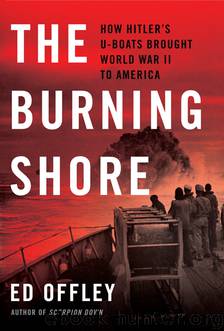
Author:Ed Offley [Offley, Ed]
Language: eng
Format: epub, mobi
ISBN: 9780465080694
Publisher: Basic Books
U-701 BEGAN ITS THIRD COMBAT PATROL on Tuesday, May 19, just five days after the first American coastal convoy set sail from Norfolk. Casting off late in the afternoon as a military band played from the U-boat bunker quayside and a small crowd of well-wishers—including U-202’s Kapitänleutnant Linder—waved farewell, Degen backed U-701 out of the Brest bunker, turned around, and conned the boat out through the opening in the harbor’s two long jetties, entering the Atlantic while two patrol boats kept station and a pair of Messerschmitt fighters circled overhead. The boat was back up to a full complement of four officers, one midshipman under training, and forty-one enlisted crewmen. Six new faces had reported aboard U-701 during its in-port period, including twenty-two-year-old Fähnrich Ingenieur (Engineering Midshipman) Günter Lange and five junior enlisted men.
The first leg of the deployment was short. U-701 made an overnight passage down the Brittany coast to the larger U-boat base at Lorient. Arriving early the next morning, shipyard workers loaded fifteen TMB seabed mines, three apiece, in its five torpedo tubes. First deployed in 1939, the TMB featured an aluminum cylindrical shell whose exterior dimensions allowed for three mines to fit inside each of the Type VIIC U-boat’s five torpedo tubes. Although at 7.5 feet it was only one-third the length of a G7e torpedo, each mine carried a much more powerful explosive charge of 1,276 pounds of hexanite, nearly twice the size of a torpedo warhead. This was possible since no propulsion system was required. The mine utilized a timing clock to delay arming the weapon until the U-boat was safely out of the area and employed a sensor whereby the magnetic field of a ship passing overhead set off the explosive. Earlier in the war, U-boats had dropped TMB mines where the water was one hundred feet deep, but subsequent engineering tests showed that the weapon’s lethality sharply increased in water eighty feet deep or less. Since channels for ships entering and departing American ports were dredged to a depth of around fifty feet or so, the only question regarding the effectiveness of the mine-laying operation was whether the U-boats could accurately drop their mines in the most highly traveled sectors of the narrow waterways.6
While in Lorient, Degen engaged in a minor deception operation of his own, telling dockyard officials that he had been unable to completely fill his diesel tanks before leaving Brest. “We wanted the expedition to last as long as possible, and that depended on how much diesel oil we could take,” Degen recalled years later. “The authorities at Lorient did not ask silly questions when we told them that fueling was not done completely in Brest.” U-701 got the additional tons of fuel oil without debate. As a result, Degen was able to make a three-day dash at high speed across the Bay of Biscay into the open Atlantic without cutting into the boat’s normal fuel allotment.
The three-week transit of the North Atlantic passed in relative calm. The U-boat
Download
This site does not store any files on its server. We only index and link to content provided by other sites. Please contact the content providers to delete copyright contents if any and email us, we'll remove relevant links or contents immediately.
| Africa | Americas |
| Arctic & Antarctica | Asia |
| Australia & Oceania | Europe |
| Middle East | Russia |
| United States | World |
| Ancient Civilizations | Military |
| Historical Study & Educational Resources |
Cat's cradle by Kurt Vonnegut(15353)
Pimp by Iceberg Slim(14506)
4 3 2 1: A Novel by Paul Auster(12392)
Underground: A Human History of the Worlds Beneath Our Feet by Will Hunt(12097)
The Radium Girls by Kate Moore(12028)
Wiseguy by Nicholas Pileggi(5784)
The Fire Next Time by James Baldwin(5444)
Perfect Rhythm by Jae(5403)
American History Stories, Volume III (Yesterday's Classics) by Pratt Mara L(5307)
Paper Towns by Green John(5190)
Pale Blue Dot by Carl Sagan(5007)
A Higher Loyalty: Truth, Lies, and Leadership by James Comey(4962)
The Mayflower and the Pilgrims' New World by Nathaniel Philbrick(4502)
The Doomsday Machine by Daniel Ellsberg(4490)
Killers of the Flower Moon: The Osage Murders and the Birth of the FBI by David Grann(4447)
The Sympathizer by Viet Thanh Nguyen(4390)
Too Much and Not the Mood by Durga Chew-Bose(4348)
The Borden Murders by Sarah Miller(4325)
Sticky Fingers by Joe Hagan(4198)
